
Recurring bills
Fixed costs from the transactions
Fixed costs are recurring fees and bills, shown as an amount per month. The kronor come from the bank. A fetched policy or loan can name the row.
The list is not a budget you write. Excluding a row changes the analysis. It does not remove the payment at the bank, and it does not create a budget line.
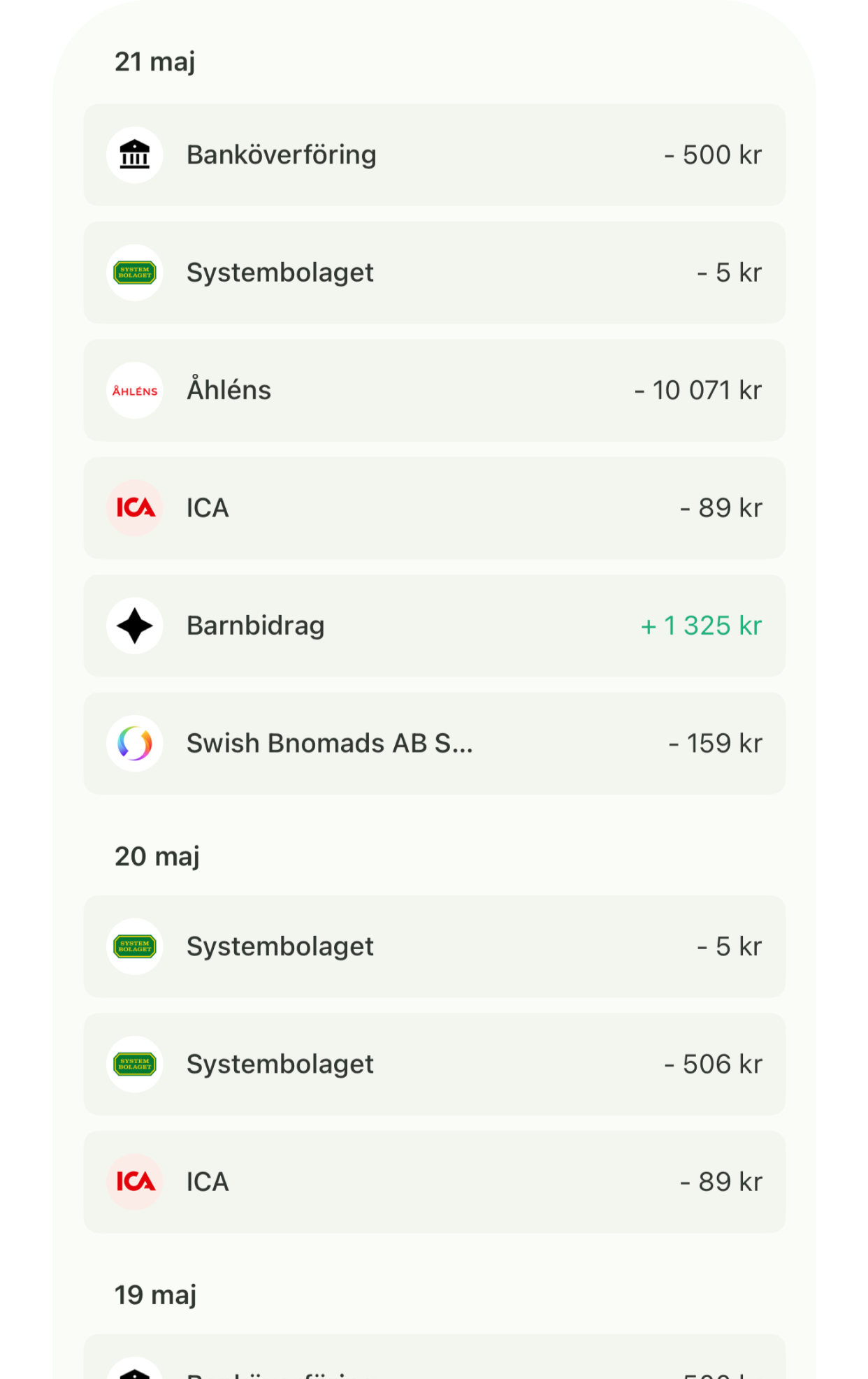


The bills are visible, but not as a month
Rent, a mortgage, home insurance, a phone and electricity leave the account on different days. On the statement they are separate rows. Together they are the part of the month that is already committed.
A spreadsheet asks you to copy every direct debit. Finton looks for the pattern in the history, from weekly to yearly, and shows a monthly amount. A thin pattern is marked as weaker evidence.
How the list is built
The premium on a fetched policy does not replace the amount that actually left the account.
- 01.The pattern is read from historyRecurring charges can be weekly through yearly. Finton converts them to a month.
- 02.A policy or a loan can name the rowIf you fetched the contract with BankID, that name can appear on the row. The kronor are still what was paid from the bank.
- 03.You can exclude a rowA merchant or a single payment can be excluded from analysis, for example a transfer that looked like a bill.
- 04.You can link or separate an insurance contractA policy can be tied to the payment, or kept apart, so the list does not double the same commitment.
Examples of rows
These are typical commitments the list can catch. The amounts are your own once an account is connected.
- Rent, a mortgage, home insurance, electricity and a mobile plan can each sit as a row with a monthly amount.
- Insurance that is charged once a year can be shown as a monthly equivalent, so it can be compared with what is charged every month.
- A transfer to your own savings account that happened to look like a bill can be excluded, so it is not counted as a fixed cost.
What the list is for
What you get
- Rent, loans, insurance, telecom and similar commitments as a monthly amount.
- A name from a fetched contract, when one exists, on top of the amount from the bank.
- A way to exclude a row that does not belong in the analysis.
The limits
- The list is inferred from payments. You do not create the row yourself.
- Subscriptions such as Spotify have their own view. This page is the bills, not the cancellation steps.
- A weak pattern is marked. That is not the same as a confirmed bill.
- Finton cannot pay the bill or change the contract.
Read next
- Subscriptions recurring services, with a yearly cost and cancellation steps where Finton has them.
- Living costs the typical month, which includes the fixed commitments.
- Insurance the payment from the bank, and the terms if you fetch them.
- Loans and mortgage rate and terms for loans you have fetched, beyond the payment itself.
- Spending where the rest of the money went.
Common questions about fixed costs
Do I create the fixed costs myself?
No. Finton reads recurring charges in the history and shows a monthly amount. You can exclude a row. That does not create a budget line.
What is the difference from subscriptions?
Subscriptions are recurring services, with a month, a year and cancellation steps when Finton has them. Fixed costs are the broader monthly amount for bills such as rent, loans, insurance and telecom.
Why does the insurance premium not match the row?
The amount on the row is what left the bank account. The premium on a fetched policy names the row. It does not replace the bank amount.
What does weaker evidence mean?
A thin pattern is marked so you can see that the recurrence is less certain. A row is not a confirmed bill just because it appears.
Can Finton pay the bills?
No. The connection is read-only.
See fixed costs in the app
Download Finton and connect a Swedish account with BankID. The list fills from the history, not from a budget you write.