
Your subscriptions
See what subscriptions cost in a year
Your subscriptions are recurring payments Finton finds in the history. Each match shows an amount per month and per year, and an estimated next date.
Cancellation steps are shown when Finton has them for that merchant. They are guidance. The app does not cancel the subscription, and it does not tell you that you should.


A small charge is hard to see across a year
A subscription that feels small each month is a different amount when it is multiplied by twelve. On the statement it sits among food, Swish and rent, so it is easy to forget what is still being charged.
Collecting subscriptions is not the same as cancelling them. Finton shows what was found, what the next charge looks like, and how a cancellation works at that merchant when the instruction exists.
How subscriptions are found
An unknown cadence is shown as provisional and is not forced into the monthly total.
- 01.The payment is found in the historyFinton looks for recurring charges and for signs of a cycle at the merchant. You do not add the subscription by hand.
- 02.Month and year are shown togetherThe detail shows name, price, next payment, account and category. The yearly amount is there so the small month can be read.
- 03.An uncertain cadence stays provisionalIf the cadence is not known it is marked as provisional. It is then not counted as a certain monthly cost.
- 04.Cancellation steps when they existFor some merchants there are steps for how you cancel with them. It is a catalogue or a hint. Finton does not carry out the cancellation.
A concrete example
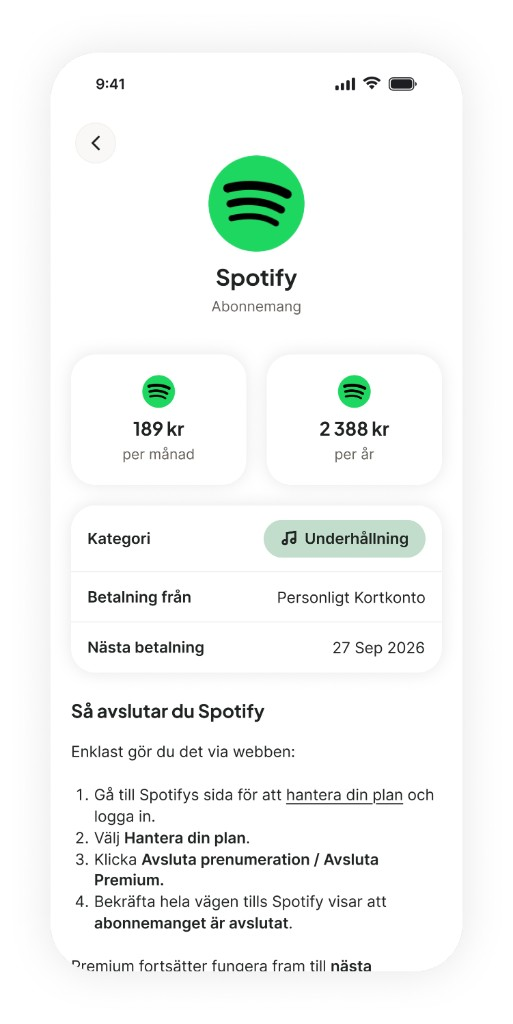
The figures come from the example image. Your subscription shows the amount that left the account.
- In the image Spotify costs 189 kronor a month and 2,388 kronor a year, with the next payment on 27 September 2026 from a personal card account.
- The same view shows the category Entertainment and the steps to cancel at Spotify: open their page, choose Manage your plan and confirm. Finton does not make those clicks.
- If a found subscription gets more expensive, a notification can say so when that type is on. The notice is about the price, not an instruction to cancel.
What the overview is for
What you get
- Subscriptions that were found, with a month and a year, without you writing a list.
- An estimated next date, plus name, account and category.
- Cancellation steps for merchants where Finton has an instruction.
The limits
- Finton does not cancel the subscription and does not decide whether you should.
- Cancellation steps exist only for merchants where an instruction exists.
- An unknown cadence is provisional and is not part of the monthly total.
- Rent, loans and insurance belong with fixed costs, not on this list.
Read next
- Fixed costs bills such as rent, loans and insurance, as a monthly amount.
- Unnecessary expenses how you can review spending that may be worth a look.
- Spending where the money went beyond subscriptions.
- Categorise spending if a subscription landed in the wrong category.
Common questions about subscriptions
Does Finton find subscriptions I did not add?
Yes. The list is built from the transaction history and from signs of a cycle at the merchant. You do not type the services in yourself.
Does Finton cancel the subscription for me?
No. The cancellation steps describe how you do it at the merchant, when Finton has an instruction. The app does not complete the cancellation and does not say that you should cancel.
Why are cancellation steps missing on a row?
The steps are shown only for merchants where Finton has an instruction. Other rows show the price and the next date without that guidance.
What does a provisional cadence mean?
The interval is uncertain. The row is not forced into the monthly total. The amount can still be shown, but not as a certain monthly cost.
Can I be told if the price goes up?
Yes, if the notification for a more expensive subscription is on. It says the price changed. It does not cancel anything.
See subscriptions in the app
Download Finton and connect a Swedish account with BankID. The yearly cost is calculated from what was actually charged.